
Newton Wood Flooring installs engineered hardwood flooring in Newton, MA and has worked on wood floors for more than 20 years, serving surrounding cities including Watertown, Brookline, Needham, Wellesley and Waltham. We recommend engineered wood where it actually earns its place: basements and lower levels, rooms over concrete, condos with underlayment rules, and wide plank floors that would move too much as solid boards.
Engineered flooring is real wood, but it behaves differently from solid hardwood, and the differences matter for where it goes and how long it lasts. The thickness of the wear layer, the build of the core and the way it is installed all affect whether it can ever be refinished and how it handles moisture.
We start with measurement. A moisture meter reading on the slab or subfloor tells us more about the right floor for a room than any sample board, and it is the first thing we take on every engineered job.
How Engineered Hardwood Is Built
The Wear Layer
The engineered wear layer is the slice of real hardwood on top, and it is the only part you see and walk on. Its thickness decides how many times the floor can be sanded in the future: a thick wear layer can take full refinishing, while a thin one can only be screened and recoated.
This is the number we look at first on any product you are considering. Two floors that look the same in the showroom can have very different lifespans because of a few millimeters of wood on top. Manufacturers publish the figure, and if a product does not, that tells you something too.
The Core and Why It Is Stable
Under the wear layer is a core of plywood or similar layers glued with their grain running in alternating directions. Because each layer resists the movement of the next, the board swells and shrinks far less with humidity than a solid board of the same species.
That stability is the whole point. It is what lets engineered flooring go into rooms where moisture varies through the year, over concrete, and in widths that would cup or gap badly as solid wood. The quality of the core varies between products, and a well-built core with more layers is usually the steadier floor.
Prefinished or Site-Finished Engineered
Most engineered flooring is prefinished, with a factory finish and small beveled edges between boards. It can be walked on soon after installation, which suits occupied houses and quick turnarounds.
Some engineered products are made unfinished so they can be sanded and coated in place, giving a flat, continuous surface and your choice of stain and sheen level. We help you choose based on how the room is used and how much future refinishing you expect.
Where Engineered Flooring Makes Sense
Basements and Lower Levels
Below grade, moisture comes up through slabs and in through foundation walls, and it changes with the seasons. Solid hardwood answers that moisture by cupping, while an engineered floor rated for below-grade use stays much flatter.
We test the slab before recommending anything, then pair the product with the vapor retarder or underlayment that the reading calls for. Matching the floor to the moisture actually measured is the difference between a basement floor that stays flat and one that fails within a season.
Condominiums With Underlayment Rules
Many condominium associations require an acoustic underlayment under hard floors to limit noise to the unit below. Engineered flooring often works well over those underlayments, especially in floating or glue-down installations.
We ask to see the association’s actual floor rules before ordering, so the underlayment and installation method match what the documents require. Finding out after installation that the floor does not comply is an expensive way to learn the rules. The documents also tend to say when work may happen and how materials come through common areas, which shapes the schedule.
Wide Plank Floors
Wide plank floors look calmer and more traditional, but wide solid boards move a great deal between a humid summer and a dry, heated winter. That movement shows up as wide winter gaps or cupping in summer.
An engineered core keeps a wide plank far more stable, which is why many wide plank floors in white oak and hickory are engineered rather than solid. You get the look without as much seasonal movement. Even so, wide engineered boards still need proper acclimation and an expansion gap, because more stable does not mean motionless.
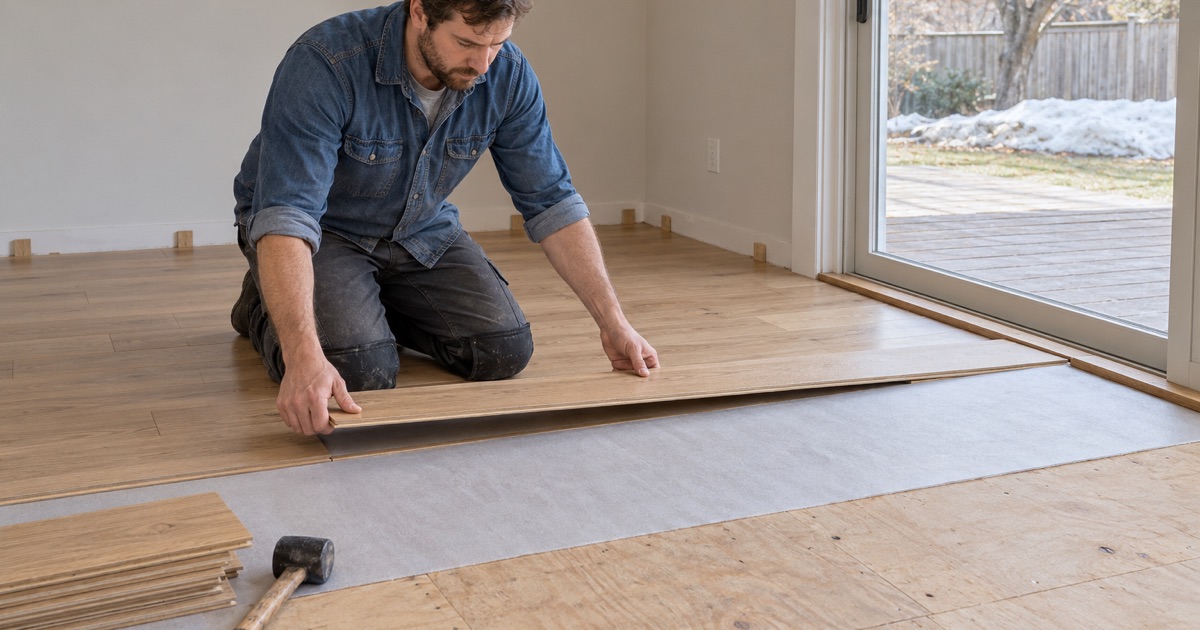
How We Install Engineered Flooring
Moisture Testing and Acclimation
Before installation, we measure the moisture of the subfloor or slab and of the flooring itself. The boards are acclimated to the conditions the manufacturer specifies, and installation starts only when both readings fall inside its range.
Skipping this step is the most common cause of trouble with any wood floor. A floor laid too wet shrinks and gaps; one laid too dry over a damp subfloor swells and cups. We record the readings so there is a clear note of the conditions the floor went down in.
Glue-Down, Nail-Down or Floating
Over concrete, engineered flooring is usually glued down or floated on an underlayment. Over a wood subfloor, many engineered products can be nailed or stapled like solid wood. Each method suits different products, subfloors and rooms.
We choose the method the manufacturer approves and the NWFA Installation Guidelines support for your conditions. The right adhesive, fastener or underlayment is part of the warranty as well as the performance.
Expansion Gaps and Transitions
Every wood floor needs an expansion gap at the walls so it can move without buckling. The gap is hidden under baseboard or quarter round, and at doorways and edges we finish with the right reducer or threshold.
Engineered flooring is often thinner than the floor in the next room, so height transitions are planned before installation starts. A transition that is thought about in advance looks deliberate; one improvised at the end looks like a mistake.
Choosing the Right Engineered Floor
Species, Cut and Grade
Engineered wear layers come in the same species as solid floors: red oak, white oak, maple, hickory and more. Rift and quartersawn white oak gives a straight, quiet grain; select grade gives a cleaner, more uniform look than character grades with more knots and color variation.
We bring samples so you can see them in your own light. Choosing the cut and grade is as important to the final look as choosing the species.
Formaldehyde and the TSCA Title VI Label
The core of an engineered floor is a composite wood product, and federal TSCA Title VI rules set formaldehyde emission limits for those products. Compliant flooring is labeled to say so.
We look for that label before installing, especially in bedrooms and closed rooms. It is a simple check that most buyers never think to make, and it takes a minute on the carton or the product documentation before the boxes are opened.
Refinishing It Later
Whether an engineered floor can be refinished in the future depends almost entirely on its wear layer. A thick one can be sanded like solid wood; a thin one is limited to screening and recoating.
If you plan to keep the floor for many years, we steer you toward a wear layer that leaves room for at least one full refinish. That choice now saves a full replacement later. For a rental or a room you expect to redo within a few years, a thinner wear layer may be perfectly sensible, and we will say so.
- 20+ Years on Wood Floors
- Stairs Quoted Tread by Tread
- Lead Checks Before Sanding