
Newton Wood Flooring has repaired hardwood floor water damage in Newton, MA for more than 20 years, serving surrounding cities including Watertown, Brookline, Needham, Wellesley and Waltham. Burst pipes, overflowing dishwashers, washing machine hoses, leaks from the unit upstairs and wet lower levels all end up in the same place: the wood floor, which swells, cups and stains when it takes on water.
The most expensive mistake after a leak is acting before the floor has finished telling you what it is going to do. Boards that look ruined on day two often flatten as they dry, and boards sanded too soon change shape again afterward. Our work starts with finding the water and measuring it, not with a sander.
We also know these floors end up in insurance claims. Every water damage job gets the documentation an adjuster needs, room by room, from the first visit to the finished floor.
What Water Does to a Hardwood Floor
Cupping, the First Sign
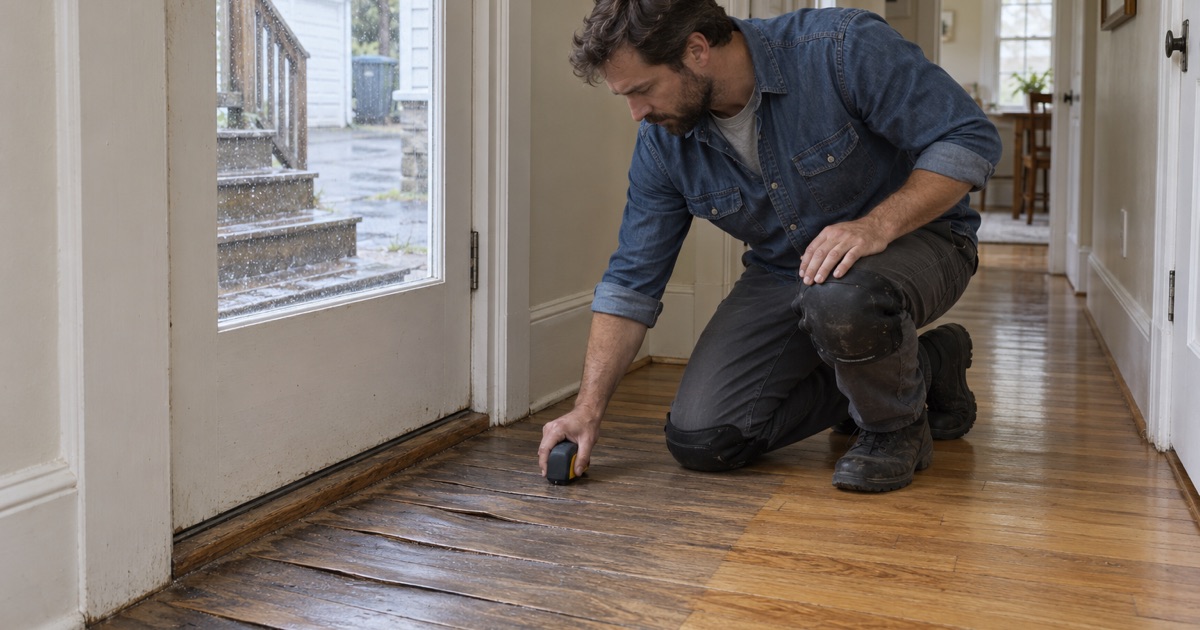
Wood swells across its width as it absorbs moisture. When the bottom of a board takes on more water than the top, the edges push up and the board cups, leaving a floor that looks rippled when you sight along it in low light.
Cupping is the floor’s warning, not its verdict. Once the source is stopped and the moisture underneath comes down, many cupped boards settle back much closer to flat. That is why we measure before we decide anything.
Crowning After an Early Sanding
Crowning is cupping in reverse: the center of each board sits higher than the edges. It is very often the result of a cupped floor being sanded flat while it was still wet underneath, so that when the bottom finally dries and shrinks, the sanded top is left humped.
The fix is patience. We track the floor with a moisture meter until the readings across the boards and the subfloor are stable, and only then plan any sanding.
Buckling and Lifted Boards
When a floor takes on enough water, the swelling has nowhere left to go and whole sections lift off the subfloor. Buckling usually follows a flood or a leak that ran for days, and it can pull fasteners loose or break tongues.
Buckled boards are taken up so the floor and subfloor can dry. Sound boards can sometimes be reinstalled once they are dry; damaged ones are replaced with matching wood.
While the boards are up, we check the expansion gap at the walls. A floor laid tight to the baseboards has no room to swell, and restoring that gap is part of keeping the repaired floor from buckling the next time humidity climbs.
Water Stains and Failed Finish
Water that sits under a rug or plant pot, or soaks in through worn finish, leaves gray or black water stains in the wood itself. Light gray marks may sand out, but black stains go deep, and those boards are replaced.
A flood can also turn an intact finish cloudy or make it lift from the wood. Even where the boards survive, the finish over the whole affected area usually has to be sanded off and renewed.
Where the Water Comes From
Burst and Frozen Pipes
Pipes that freeze and split during a cold snap, often in exterior walls or unheated spaces, can release a lot of water fast. The floor nearest the break usually takes the worst of it, but water travels along joists and under boards well beyond the visible wet spot. We map the moisture across the whole area, not just the obvious puddle, so hidden wet zones are not left under a repaired floor.
Dishwashers, Washers and Fridge Lines
Appliance leaks are often slow, which makes them worse. A dishwasher or ice maker line can leak under the floor for weeks before anyone sees a stain at the edge of the cabinet, and by then the subfloor may be soft. The appliance is pulled, the source is repaired by the right trade, and we check the subfloor and the boards running under the cabinets before any repair starts.
Wet Basements and Lower Levels
Below grade, water can come up through the slab or in through foundation walls, and the moisture is often seasonal rather than a single event. A finished basement floor can fail slowly without any visible leak.
We measure what the floor is actually sitting over. Solid hardwood rarely belongs back in a damp lower level, so a replacement there is usually engineered flooring over a vapor retarder suited to the measured moisture.
Our Step-by-Step Water Damage Process
1. Stop and Trace the Water
The source comes first, whether that is a fitting, an appliance, a roof, a window or the unit upstairs. We follow the moisture from the floor back to where it entered, because a repair over an active leak is wasted money.
The plumbing, roofing or appliance repair itself belongs to the right trade. Our part is confirming the floor has stopped taking on water, which the moisture readings in the next step will show either way.
2. Dry and Measure
Wet rugs and furniture come off the floor, air is kept moving, and we take moisture meter readings at marked points across the boards and the subfloor. Repeating those readings over several days shows whether the floor is drying, and how fast.
We compare the wet area against a dry reference spot of the same floor elsewhere in the house. A board is ready when it reads like its own dry neighbors, not when it reaches a number printed in a chart for some other house.
3. Decide What Can Be Saved
When the readings settle, the floor shows what it will be. Boards that dried flat and sound stay; boards that are stained black, split or still lifting are marked for replacement. You get the decision board by board, not as a guess made on the first day.
4. Repair and Refinish
Damaged boards are cut out and replacements woven in with matching wood, the subfloor is repaired where it softened, and the room is sanded and finished so the repair disappears into the floor around it.
If the damage was limited to one area, we tell you whether a blended repair will match or whether the room needs a full refinish to look even. That choice, and its price, is settled before the replacement boards go in.
Insurance, Condos and Paperwork
Room-by-Room Records for the Adjuster
We document water-damaged floors room by room for the adjuster: photos at each visit, moisture readings at the same marked points, and a written note of which boards can be saved and which cannot. Consistent records from the start make it much easier to agree on the scope. The same record helps after the job is done, if a question comes up about what was damaged and what was repaired.
Sudden Leaks Against Seepage Below Grade
Many homeowners policies treat water from a sudden burst pipe differently from water that seeps in from the ground or backs up from a drain. We cannot tell you what your policy covers, and we do not try to.
What we can do is document where the water came from and what it did. That record lets you and your agent read the policy against what actually happened.
When the Leak Came From Upstairs
In a condominium or a two-family, the floor that is damaged is often not in the unit where the leak started. Who pays depends on the association’s documents and the insurance policies involved, and the owners rarely agree right away. We trace the moisture path from its source to your floor and give everyone the same written scope, which is usually the quickest way to settle who repairs what.
- 20+ Years on Wood Floors
- Stairs Quoted Tread by Tread
- Lead Checks Before Sanding