Newton Wood Flooring has spent more than 20 years on wood-flooring in Norwood and the towns around our Newton base, and a good share of that work starts with water. We sand and refinish original oak, maple and pine, lay new boards, and repair floors that took on water from below. In this town, that water most often arrives through the storm drains.
Our approach to a wet floor is the same whether the source is a burst pipe or a backed-up drain. We trace where the water came from, dry the room, and read the boards and subfloor with a moisture meter before anything is pulled up or replaced. Guessing at moisture is how a repaired floor cups again in the first humid month.
This page covers what changes about that work in Norwood specifically: the storms that overwhelmed the drainage, the town’s long-running plan to fix it, and what we do for ground-floor and lower-level floors in the meantime. If your floor has already been through a storm, the last section explains how we decide between repairing, refinishing and replacing it.
Wood Floors in a Town Whose Storm Drains Back Up
Norwood is a town of 31,611 people on the Neponset River, which runs from Foxborough all the way to Boston Harbor. Much of its housing is old, and much of the drainage under its streets is older, and the two meet in lower-level rooms whenever a heavy storm outruns the pipes.
Old Houses Sitting on Older Pipes
Census figures show 24.9 percent of Norwood’s 13,815 housing units were built in 1939 or earlier. Many of those houses still carry their original strip oak, often red oak strip flooring nailed through the tongue to a board subfloor, and some have had a basement room or a converted garage finished out since. Those finished lower rooms are where storm water usually finds wood.
The drainage under the streets is older still. Reporting after the 2020 flood described drainage dating from around the town’s 1872 incorporation as not built to handle this kind of water. That does not mean a given house will flood, but it does mean we treat moisture in a Norwood lower level as a known risk rather than an exception.
Owners Making Long-Term Decisions
About 54.0 percent of Norwood’s occupied homes are owner-occupied, according to the Census Bureau’s 2024 five-year estimates. Owners tend to ask a longer question than a quick patch: should a finished basement get wood at all, and if so, what kind? We answer it from moisture readings taken in that room, not from a general rule about basements.
Where readings run high, we usually recommend engineered wood with a proper vapor retarder rather than solid hardwood below grade. Engineered boards move less as humidity swings, and a thick engineered wear layer can still be sanded later. Solid strip flooring stays the right choice upstairs, where the original floors usually are and where we would rather refinish than replace.
Ground-Floor Rooms Need a Plan Too
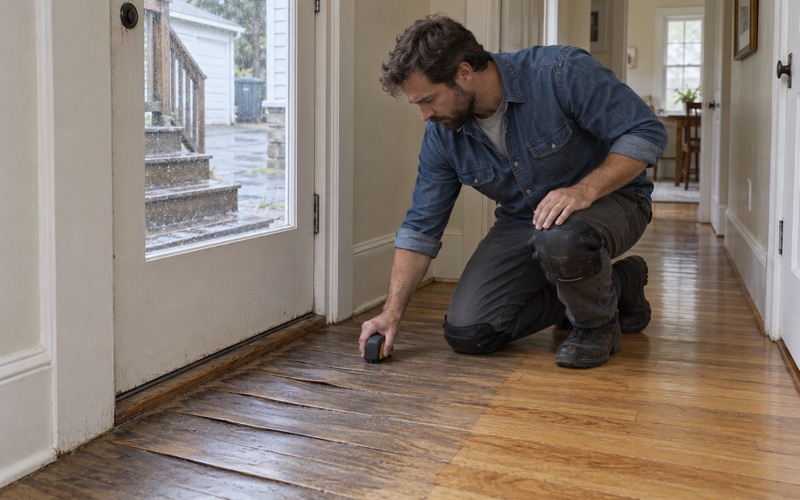
Water does not only come up through basements. A converted garage or a family room set a step down from grade can take water through a door threshold when the street floods and the yard cannot drain. In those rooms we check the expansion gap at the walls and the transitions at each reducer and threshold, since that is where water wicks in first.
We also talk through simple protection. Rugs with rubber backing trap moisture against a finish, a dehumidifier in a lower level helps through humid summers, and keeping valuables off the floor in a storm-prone room saves a lot of grief. None of that replaces a fix to the drains, but it limits what a bad night costs.
Looking for wood-flooring closer to Chelsea? See Chelsea Wood-Flooring.
June 28, 2020, the 1998 Storm, and the Meadow Brook Plan
Norwood’s flooding is not a matter of one unlucky storm. Two events in particular shaped how the town talks about drainage, and a study that began more than four decades ago is now moving toward construction. Knowing that timeline helps an owner judge how much protection a lower-level floor needs right now.
The Flash Flood Emergency That Closed the Hospital
On Sunday, June 28, 2020, slow-moving thunderstorms kept rebuilding over the same ground and dropped at least three inches of rain in nearly 90 minutes. The National Weather Service in Boston issued its first Flash Flood Emergency since 2014. Cottage Street flooded heavily, and the Neponset River climbed about four feet within minutes.
Norwood Hospital, with its parking lot in a low-lying area, was closed by the flooding, and the storm caused significant damage to many other businesses and homes. For wood floors, a storm like that is the worst case: water arrives fast, often carrying silt, and it can sit in a finished lower level for hours before anyone can get to it.
A Pattern Going Back to 1998
The 2020 flood was not the first. A local opinion piece by a District 4 Town Meeting Member notes that a June 13, 1998 storm destroyed the Police and Fire Station. Two storms twenty-two years apart, each heavy enough to take out a major public building, explain why so many Norwood owners now ask us about lower-level floors before they build.
Meadow Brook and the Hennessey Field Basin
The town’s response centers on the Meadow Brook watershed. The Meadow Brook Drainage Study was completed in 1980 and updated in 2004 and again in 2022. The current plan proposes a stormwater detention basin at Hennessey Field, about 7.55 acres of heavily forested open land, and Stantec, the town’s stormwater engineering firm, is reported to be nearing the end of design.
Stormwater projects are scheduled for 2027-2029, and residents hope the work will mean fewer flooded basements and garages in heavy rain. Cost estimates presented to the town have varied, and nothing here should be read as a promise about any one street. Until the work is built and tested by real storms, we plan floors in low rooms as if water can still arrive.
When Storm Water Comes Up Into a Basement or Garage Room
The hours after a backup decide whether a wood floor can be saved. Our work in a flooded Norwood room follows a fixed order, because skipping a step is what turns a repairable floor into a replacement. The order is the same for an overflowing appliance, but storm water adds silt and urgency.
First Hours: Get the Water Out
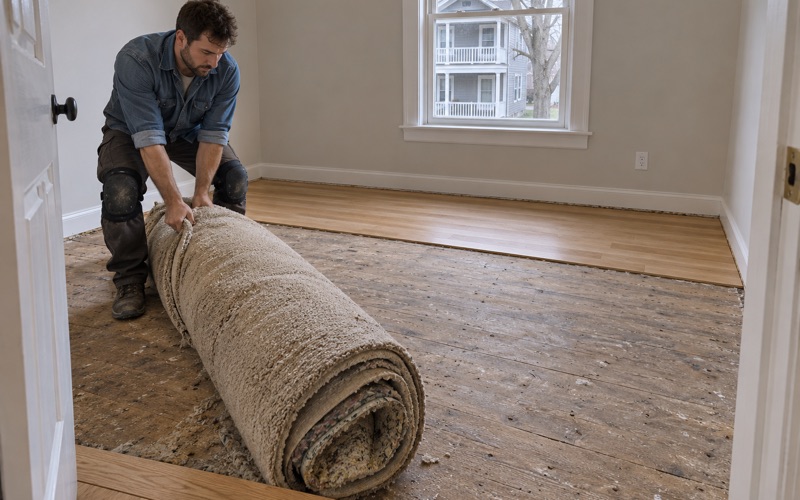
Standing water comes out first, then wet rugs, carpet pad and anything sitting on the boards. Baseboards and quarter round often come off so air can reach the edge of the floor and the expansion gap behind it. If the storm water carried silt or sewage from a backed-up drain, cleanup and sanitizing come before any drying equipment goes in.
Speed matters more than anything else in this stage. A floor that is dried within the first day or two has a far better chance of flattening out than one left to sit through a weekend, and mold behind baseboards becomes a separate problem once moisture lingers in the wall cavity.
Drying and Reading the Boards
We dry the room with dehumidifiers and air movement, then read the boards and the subfloor with a moisture meter at points across the floor, not only at the obvious wet spot. Readings get compared against a dry area of the same floor upstairs, so we know what normal looks like in that house before calling the job dry.
Wet strip flooring usually cups first, with board edges rising above the centers. Sand it flat while it is still wet and it crowns as it dries, leaving a hump down each board. That is why we wait for the readings, not the calendar, before any sanding or board replacement starts.
Buckling, Subfloors and What Lies Beneath
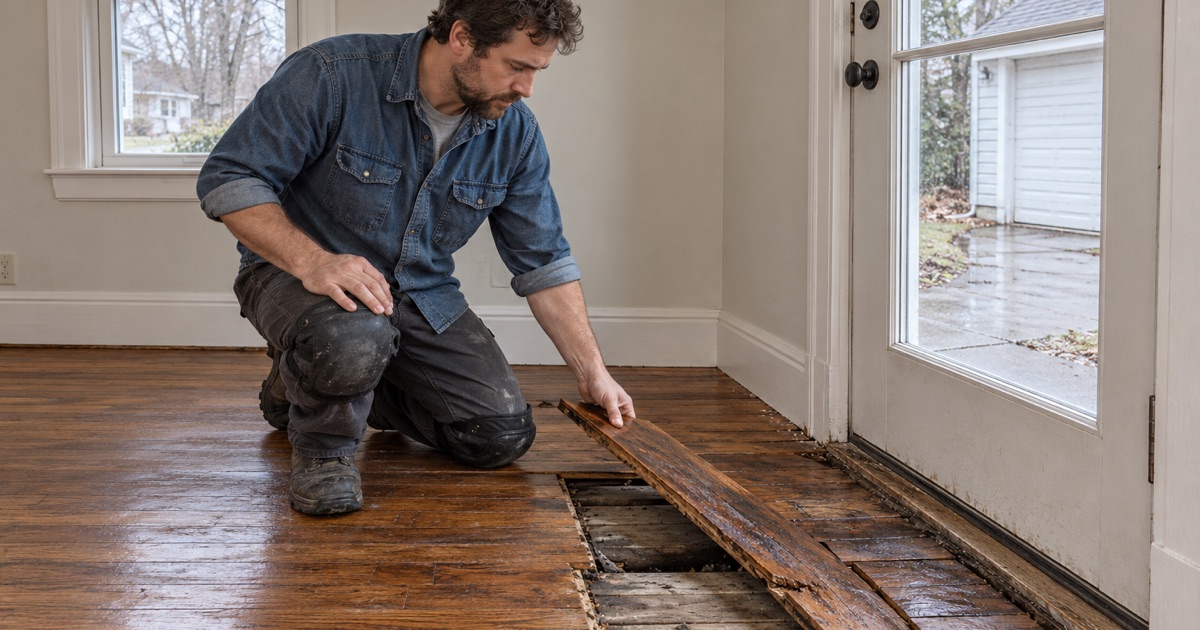
When boards swell enough to push against each other and the walls, the floor can buckle and lift off the subfloor. Those boards rarely go back down cleanly. We pull them, check the subfloor and the joist bays below for lingering water, and confirm that the underlayment and any vapor retarder are dry before new wood goes down.
In older lower levels we sometimes find resilient floor tile under a later wood floor, with black mastic beneath it. Those older materials can contain asbestos, so we identify them rather than disturb them, and work stops until the right trade has handled them. A flood is no reason to skip that step.
Paperwork for the Adjuster
Storm claims move faster with clear records. We document water-damaged floors room by room, with photos, moisture readings, square footage and a note of which boards came out, so the adjuster sees the same floor we saw. Whether a policy covers storm water or a drain backup is between you and your insurer, but good documentation helps either way.
Repairing and Refinishing After a Norwood Storm
Once a floor reads dry, most of the decisions come down to how much wood is left and how far the damage reaches. Many Norwood floors that took water can be repaired and refinished rather than torn out, especially original prewar oak that still has good thickness above the tongue.
Measuring What Is Left Before Sanding
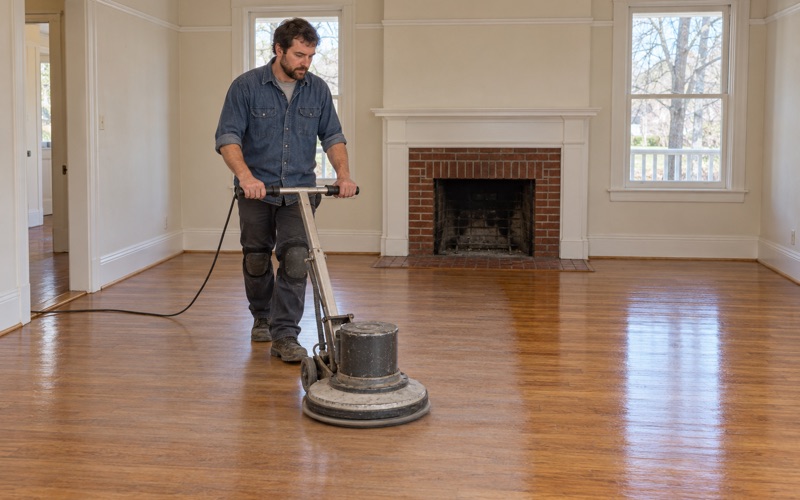
Before promising a full sanding, we pull a vent cover or a threshold and look at how much wood remains above the tongue. Old strip floors that have been sanded several times can be close to their limit. If the margin is thin, a screen and recoat or a partial repair may be wiser than taking the whole floor down again.
Because much of Norwood’s housing is older, we also check the build year and any painted surfaces before sanding. Massachusetts runs its own lead-safe renovation rules for homes built before 1978, and painted baseboards or stair risers near the floor can turn a routine sanding into a regulated job. We sort that out before the drum sander arrives.
Weaving In Replacement Boards
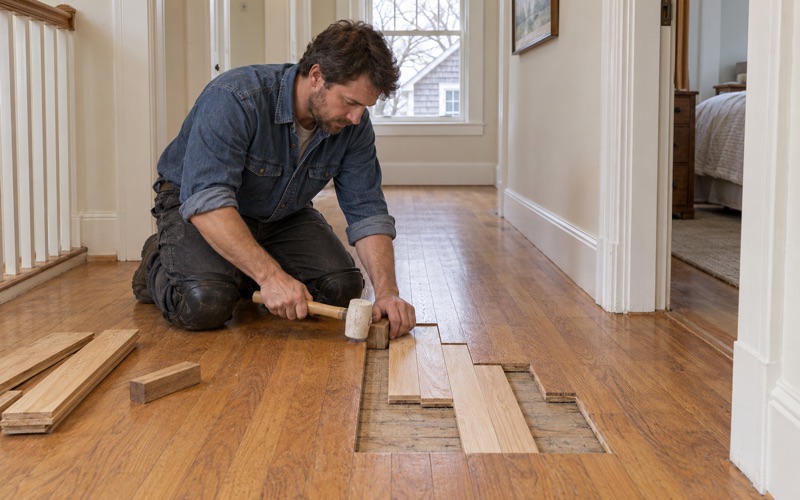
Where boards are too damaged to sand flat, we cut them out and weave in matching boards, staggering the joints so the repair reads as floor rather than as a patch. Species, width and grade are matched to what is there, whether red oak strip, white oak or maple, and the new wood acclimates in the house first.
Water stains that went black deep into the grain usually mean board replacement, since sanding cannot reach them. Lighter gray staining sometimes sands out. We test a small area first, because promising a stain will disappear and then finding it runs through the board is how expectations go wrong.
Choosing a Finish for a Room That Might Flood Again
In a lower-level room with a flood history, we often lean toward a durable waterborne polyurethane that fits the Massachusetts VOC limits for wood coatings, which are stricter than the federal ones. Before any new finish goes down, old wax and cleaning-product residue are tested and removed, so the coat bonds instead of peeling.
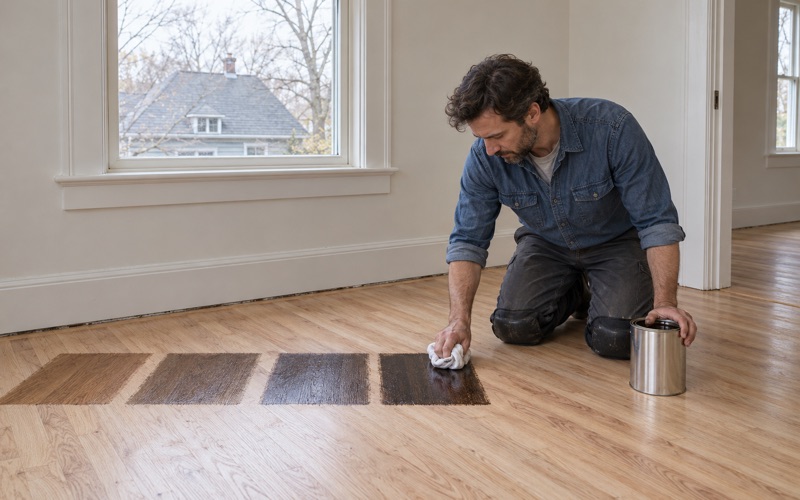
Color is chosen on your own floor. We lay stain samples on the repaired boards in the room’s actual light, which matters more in a basement with small windows than anywhere upstairs. The goal is a floor where the replaced boards, the refinished originals and the stain all read as one surface.
- 20+ Years on Wood Floors
- Stairs Quoted Tread by Tread
- Lead Checks Before Sanding